





16 September 2026
Most oncologists agree on one thing: early detection changes outcomes more than almost anything else in cancer care. Cancer screening in India today relies on a set of proven tools, mammography, Pap smear and HPV testing, low-dose CT, colonoscopy, PSA testing, and select blood-based tumour markers chosen based on a person's age, sex, and individual risk profile. Screening isn't about diagnosing cancer outright. It's about spotting warning signs before symptoms even appear, which is precisely when treatment options are widest.
What Is Cancer Screening?
Screening is done on people who feel completely well, which is what separates it from diagnostic testing ordered after symptoms show up. The goal is to catch precancerous changes or very early-stage disease, while there's still the most room to act. There's no single test that works for everyone, what's appropriate depends on age, family history, lifestyle factors like smoking, and any past medical history.
Who Should Consider Screening?
A few factors typically push someone toward earlier or more frequent testing:
-
Age, since several cancers are screened for starting somewhere between 40 and 50
-
A close family member who's had cancer
-
Long-term tobacco or alcohol use
-
Chronic infections, such as HPV or Hepatitis B/C
-
Prolonged exposure to certain occupational or environmental carcinogens
-
A prior test result that flagged something abnormal
None of these guarantee a cancer diagnosis. They're simply reasons to have a conversation with a doctor about a screening schedule suited to you, rather than following a generic timeline.
Cancer Screening Tests in India: What They Involve
Here's a closer look at the cancer screening tests in India used most often:
-
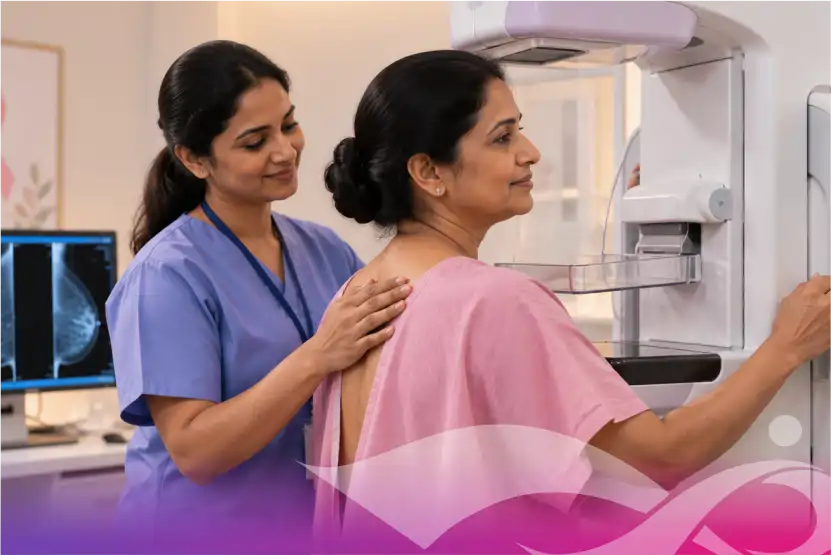
Mammography for breast cancer, generally recommended at regular intervals from a certain age, earlier if there's a family history
-
Pap smear and HPV DNA testing for cervical cancer
-
Low-dose CT scan for lung cancer, mainly for people with a long smoking history
-
Colonoscopy or stool-based testing for colorectal cancer
-
PSA blood test to assess prostate-related risk in men
-
Oral and throat examinations, particularly relevant given how common tobacco-related cancers are in the country
-
Blood tests and tumour markers, used alongside imaging rather than as a stand-alone diagnostic tool
None of these tests work in isolation, and an abnormal result is a starting point for further evaluation, not a diagnosis on its own.
How Screening Leads to Diagnosis and Treatment Planning
When a screening test flags something unusual, the next step is usually a more targeted work-up this might include a biopsy, a PET-CT, or molecular testing, depending on what's suspected. From there, specialists review the findings together, because what happens next depends entirely on the cancer type, its stage, and the person's overall health. This is where early cancer detection in India genuinely makes a difference, since catching disease at this stage often keeps more treatment paths open.
Choosing a Cancer Screening Hospital in India
Screening centres aren't all built the same way. When evaluating a cancer screening hospital in India, it's worth looking for one where diagnostic imaging and pathology are handled in-house, where borderline results are reviewed by a team rather than a single doctor, and where there's a clear, connected path from screening into treatment if something is found. People searching for the best cancer screening centre in India are usually looking for exactly this kind of continuity, rather than a facility that only performs the test and stops there.
IOCI (International Oncology Cancer Institute) follows this model, bringing diagnostic testing, medical oncology, surgical oncology, and radiation oncology together across its hospital network in India, rather than leaving patients to coordinate between separate providers. Screening findings are reviewed through IOCI's International Tumour Board, where specialists from different disciplines assess the same case together before recommending next steps.
When Should You Consult a Specialist?
It's worth speaking with a specialist if you fall into a recommended screening age group, have a relevant family history, or have received a screening result that is marked as "abnormal" or "indeterminate." A persistent symptom that doesn't go away is also reason enough to get checked, even if you don't consider yourself high-risk. If you already have a report from elsewhere and want another expert opinion before deciding on a plan, IOCI's Second Opinion service is available for that as well.
Conclusion
Cancer screening in India remains one of the most effective tools available for catching disease early, when treatment choices tend to be the broadest. If you're due for a screening test or unsure which one applies to you, IOCI's diagnostic and oncology team, supported by its International Tumour Board, can help you determine the right next step. You can book an appointment or explore IOCI's Second Opinion service to get started.